Downtown Jebel Ali Area Guide: Living, Working and Investing in Dubai’s Southern Corridor
What Downtown Jebel Ali actually is, what is there now, what is scheduled to arrive, and the honest trade a buyer makes in a district that is still being assembled.

Downtown Jebel Ali is a designated freehold district in southern Dubai, set on Sheikh Zayed Road between the Jebel Ali Free Zone and Dubai Investment Park. It is a working district rather than a resort one, and its residential stock is young because most of it is still being delivered.
That last sentence is the whole area guide in miniature. Everything attractive about Downtown Jebel Ali and everything difficult about it flows from the same fact: it is a district being assembled rather than one already built.
Where exactly is it?
The district sits on the E11, Sheikh Zayed Road, in the southern half of Dubai, within the wider Jebel Ali area. To the west lies the Jebel Ali Free Zone and the port. To the south east is Dubai Investment Park. Further south again are Expo City Dubai and Al Maktoum International Airport.
Its position on the road is the defining characteristic. You join the E11 directly, and that one road carries you north through Dubai Marina, Media City and Business Bay into Downtown Dubai, or south towards Abu Dhabi. For a district in the south of the city, that is a materially better proposition than being set back behind a network of feeder roads.
How do you get around?
Three Dubai Metro Red Line stations serve the wider Jebel Ali district: Ibn Battuta, Danube and UAE Exchange. Ibn Battuta sits beside the mall of the same name and is the closest of the three to the retail and bus interchange. Danube is the station closest to Jebel Ali Free Zone.
The Red Line runs alongside Sheikh Zayed Road for most of its length, which means a metro commute from here follows the same corridor as the drive, but without the traffic. For anyone working along the SZR spine, that redundancy is worth more than a headline distance to any single destination.
A note on precision. Developers in this district commonly state that the Dubai Metro is within twenty minutes. That is a drive time claim, not a walking distance, and it does not name a station. Ask which station, and check the walk, before you assume a car free life is practical from a specific building.
Beyond the metro, the RTA bus network serves the area, with Ibn Battuta Bus Station as the main interchange. Public transport information for all modes is published by the Roads and Transport Authority.
What is the economy here?
This is where Downtown Jebel Ali differs from most residential districts. It is attached to one of the largest industrial and logistics economies in the region.
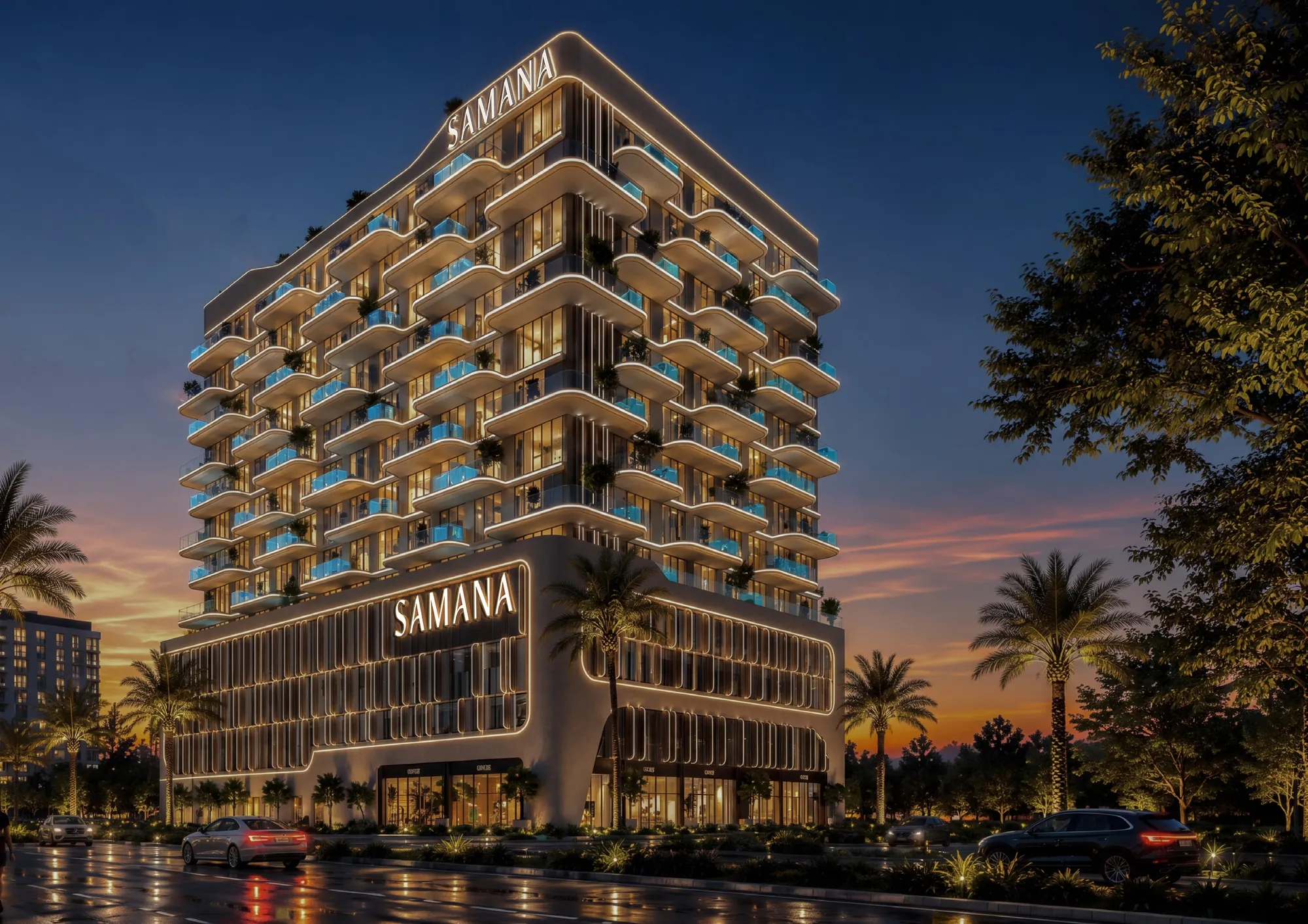
SAMANA Developers publishes the following figures for the Jebel Ali district in the Samana Portside brochure: more than thirty six per cent of Dubai’s GDP contributed by the district, seventy four per cent of foreign direct investment across key sectors, more than eleven thousand companies operating there, and more than one hundred Fortune 500 companies with a presence. Those are developer published figures attributed to unnamed verified sources, so treat them as marketing material rather than as audited statistics, but the direction they point in is not controversial: this is a working district with a large daytime population.
For a residential buyer the practical consequence is tenant demand. A district with a free zone, a port and eleven thousand companies has a structural need for housing near it, and historically the housing supply in Jebel Ali has lagged the employment.
What is actually there today?
Being straightforward about this is more useful than a list of everything within a twenty minute drive.
Retail and daily needs. Ibn Battuta Mall is the anchor, and it is a full scale mall with a metro station attached. Beyond that, the immediate area is thin on the small scale retail that makes a neighbourhood feel finished. Several new residential buildings, Samana Portside among them, include ground floor retail units precisely because of this gap.
Leisure. Dubai Marina and Jumeirah Beach Residence are within the twenty minute band for beaches and restaurants. Expo City Dubai adds cultural and business programming to the south.
Schools and healthcare. This is the weakest part of the picture, and it is the honest reason the district suits some buyers and not others. There is no dense provision of schools or hospitals within walking distance of most new developments here. Families should map their specific requirements before committing.
Green space. Limited and largely provided within developments rather than publicly. Podium amenity decks are doing the work that parks do elsewhere.
What is scheduled to arrive?
Three things dominate the forward picture, and they are the reason the district trades on its future rather than its present.
Al Maktoum International Airport. The expansion is the largest single infrastructure project in the area, reported at roughly AED 128 billion and targeting an ultimate design capacity of 260 million passengers a year. We have set out the phasing and what it means for property here in the airport expansion guide.
Palm Jebel Ali. The revived waterfront development sits within the twenty minute band and is designed to add substantial coastline and resort capacity to the west of the district.
Expo City Dubai. Now a permanent mixed use district rather than an event site, bringing business, culture and residential development to the corridor south of Jebel Ali.
Each of these is a multi year programme. None of them is finished. A purchase here is, in large part, a position on whether that pipeline broadly delivers.
What does property cost, and what does it yield?
Market reporting through 2026 puts average apartment sale prices in Downtown Jebel Ali in the region of AED 1.07 million, with a range on price per square foot roughly between AED 600 and AED 1,000, and prices up around four per cent over a six month window. On yields, reported figures cluster between five and eight per cent gross depending on unit type and source, against a Dubai wide range of roughly six to eight per cent.
Those are third party estimates for existing stock. They are not a forecast for any specific building, and they are not developer figures. Anyone quoting you a precise yield for an unbuilt project is extrapolating, and you are entitled to ask from what.
The wider market context is that Dubai recorded roughly AED 419.9 billion of real estate transactions across 112,850 deals in the first half of 2026, with off plan accounting for AED 139.75 billion across 58,840 transactions. Off plan is not a fringe activity in this market; it is more than half the deal count.
Who does Downtown Jebel Ali suit?
- People working in the corridor. Jebel Ali Free Zone, the port, Dubai South, Expo City. A short commute here is genuinely short, and it does not depend on the E11 at rush hour.
- Investors taking a forward view. The thesis is the airport, Palm Jebel Ali and Expo City, on a horizon measured in years rather than quarters.
- Buyers priced out of the SZR corridor further north. The same road, the same metro line, at a different price.
It suits less well if you want a finished neighbourhood now, a school or hospital within walking distance, or a beachfront address. Those are not flaws to be argued away. They are the trade you are making, and making it knowingly is the difference between a good decision and a lucky one.
Questions people ask about Downtown Jebel Ali
Is Downtown Jebel Ali freehold?
Yes, it is a designated freehold area, so buyers of any nationality can generally own there outright. Confirm your position with the Dubai Land Department or a licensed agent.
Is it the same as Jebel Ali Village or Jebel Ali Industrial Area?
No. Jebel Ali is a large area containing several distinct districts. Downtown Jebel Ali is the freehold residential district on Sheikh Zayed Road, and it should not be confused with the industrial areas or with the older Jebel Ali Village.
How far is Dubai Marina?
Within twenty minutes according to developer material. As with all such claims, that is a drive time under favourable conditions rather than a guaranteed journey.
Is it a good place to live with children?
It can be, but school proximity is the constraint rather than the housing. Map your school options first and the property second if this matters to you.
What is being built there now?
A number of off plan residential projects, including Samana Portside, are under way. Completed supply remains limited, which is why so much of the area guide is written in the future tense.
What is it like to live here day to day?
Area guides tend to list amenities and stop. The more useful question is what the rhythm of a week actually looks like, so here is an honest attempt at it.
The commute. If you work along the Sheikh Zayed Road corridor, this is a straightforward place to live. You have a direct road and a parallel metro line, which is a genuine redundancy: when one is bad, the other usually is not. If you work in Deira, Dubai Festival City or anywhere requiring a cross city journey, you will feel the distance, particularly at peak.
The weekly shop. Ibn Battuta Mall covers full scale retail and has a metro station attached. What the district is short of is the small stuff, the corner supermarket and the pharmacy you walk to rather than drive to. New developments with ground floor retail are gradually filling that in.
Evenings. Dubai Marina and Jumeirah Beach Residence are the realistic destinations for restaurants and beach, inside the twenty minute band. Within the district itself, the evening offering is thin today.
Weekends. The coastline near Palm Jebel Ali, Expo City Dubai programming, and the wider Marina and JBR strip. Again, the pattern is that the district is a base rather than a destination.
If that reads as a district with more road than atmosphere, that is a fair summary of 2026. The question a buyer is really answering is whether they believe the atmosphere follows the infrastructure, which in Dubai it historically has, on a lag measured in years.
How does it compare with the alternatives?
Most buyers looking at Downtown Jebel Ali are also looking at one or two of the following, and the trade offs are reasonably clear.
| District | What it offers over Downtown Jebel Ali | What you give up |
|---|---|---|
| Dubai Marina | Finished neighbourhood, beach, dense amenity | Materially higher entry price per square foot |
| Dubai South | Closer to the airport itself, newer masterplanning | Further from Sheikh Zayed Road and the metro line |
| Jumeirah Village Circle | Established rental market, more completed stock | No metro on the doorstep, no SZR frontage |
| Downtown Jebel Ali | SZR frontage plus metro at a lower price point | Immature amenity, limited completed supply |
Read across that table and a pattern emerges. Downtown Jebel Ali is competing on access rather than on amenity, and its case rests on the proposition that access is the harder thing to add later. Roads and metro lines are close to permanent. Cafes and clinics arrive when the population does.
What should you check before buying here?
- Walk the actual route to the metro from the specific building, at the time of day you would use it. A twenty minute drive claim tells you nothing about a ten minute walk in August.
- Map your schools and healthcare before the property, if either matters to you. This is the district’s weakest dimension and it is not something a building can solve.
- Ask what is being built next door. In a district at this stage, your view and your construction noise for the next several years are both determined by the neighbouring plots.
- Check the supply pipeline, not just the demand story. A large number of simultaneous completions along the same corridor affects rents even when the long term thesis holds.
- Confirm freehold status and registration for the specific plot through the Dubai Land Department rather than relying on a general statement about the district.
The honest summary
Downtown Jebel Ali is an access play in a district that is still under construction, attached to one of the largest industrial economies in the region and sitting between two very large infrastructure programmes. The road and the metro are real and here today. The airport, Palm Jebel Ali and Expo City are real and largely still coming.
If your horizon is long enough to hold through the delivery of that pipeline, the district makes sense on its fundamentals. If you need a finished neighbourhood now, it does not, and no amount of forward looking argument changes that.
For how this plays out at building level, see the Samana Portside location analysis and the airport expansion guide.
Next steps on Samana Portside
Related guides

Buying in Dubai as a Foreign National: Freehold, the Golden Visa and the Real Thresholds
What foreign nationals can actually own in Dubai, how the Golden Visa property route really works, the published fees, and the detail that trips up off plan buyers.
20 August 2026 9 min read

Fees and Costs When Buying Off Plan in Dubai: The Full Breakdown
Every cost that sits outside the purchase price on a Dubai off plan purchase, when each one falls due, and the ones buyers most often forget to budget for.
20 August 2026 8 min read

Buying Off Plan in Dubai: Escrow, Oqood and the SPA, Step by Step
The full process of an off plan purchase in Dubai, the protections that sit underneath it, and the specific checks that separate a safe transaction from a careless one.
20 August 2026 9 min read
Ask for availability and the current price list
Send your details and our team will come back with the units still open, the layouts that match your budget, and the unit areas as soon as the developer releases them.