How the Al Maktoum Airport Expansion Reshapes Jebel Ali Property
The reported scale and phasing of the Al Maktoum International expansion, and what a buyer with a 2029 handover should actually take from it.

Al Maktoum International Airport, known as DWC, is being expanded into what is intended to be the largest airport in the world by capacity. For anyone buying property in Jebel Ali, Dubai South or the wider southern corridor, it is the single most consequential piece of infrastructure in the area, and it is worth understanding at the level of phasing rather than headline.
This guide sets out what has been reported, on what timeline, and what a buyer with a handover in the late 2020s should actually take from it. The figures here come from press reporting on the expansion programme rather than from any developer, and they are labelled as such throughout.
What is the scale of the project?
| Measure | Reported figure |
|---|---|
| Investment | Approximately AED 128 billion |
| Ultimate design capacity | 260 million passengers a year |
| First phase capacity target | 150 million passengers a year |
| Cargo capacity | 12 million tonnes a year |
For scale, Dubai International Airport has historically handled in the region of ninety million passengers a year. A 260 million passenger design capacity is not an incremental upgrade. It is the construction of a new aviation centre of gravity for the city, roughly forty kilometres south west of the existing one.
What is the timeline?
Reported phasing runs roughly as follows.
- 2024 to 2027. Infrastructure and foundation works. As of mid 2026, contractors were reported to have completed more than seventeen thousand concrete piles, moved over forty five million cubic metres of excavation, and finished a second runway, with a workforce approaching nine thousand.
- 2028 to 2032. Terminal 1 and Concourse 1, enabling the first 150 million passenger phase.
- 2033 to 2035. Phased migration of major airlines, including Emirates and flydubai, from Dubai International.
A new metro line linking the airport directly to central Dubai forms part of the ultimate development plan.
Why does the phasing matter more than the headline?
Because the headline number, 260 million passengers, describes a state of the world in the 2030s or later, while most buyers are making decisions with a horizon of three to seven years.
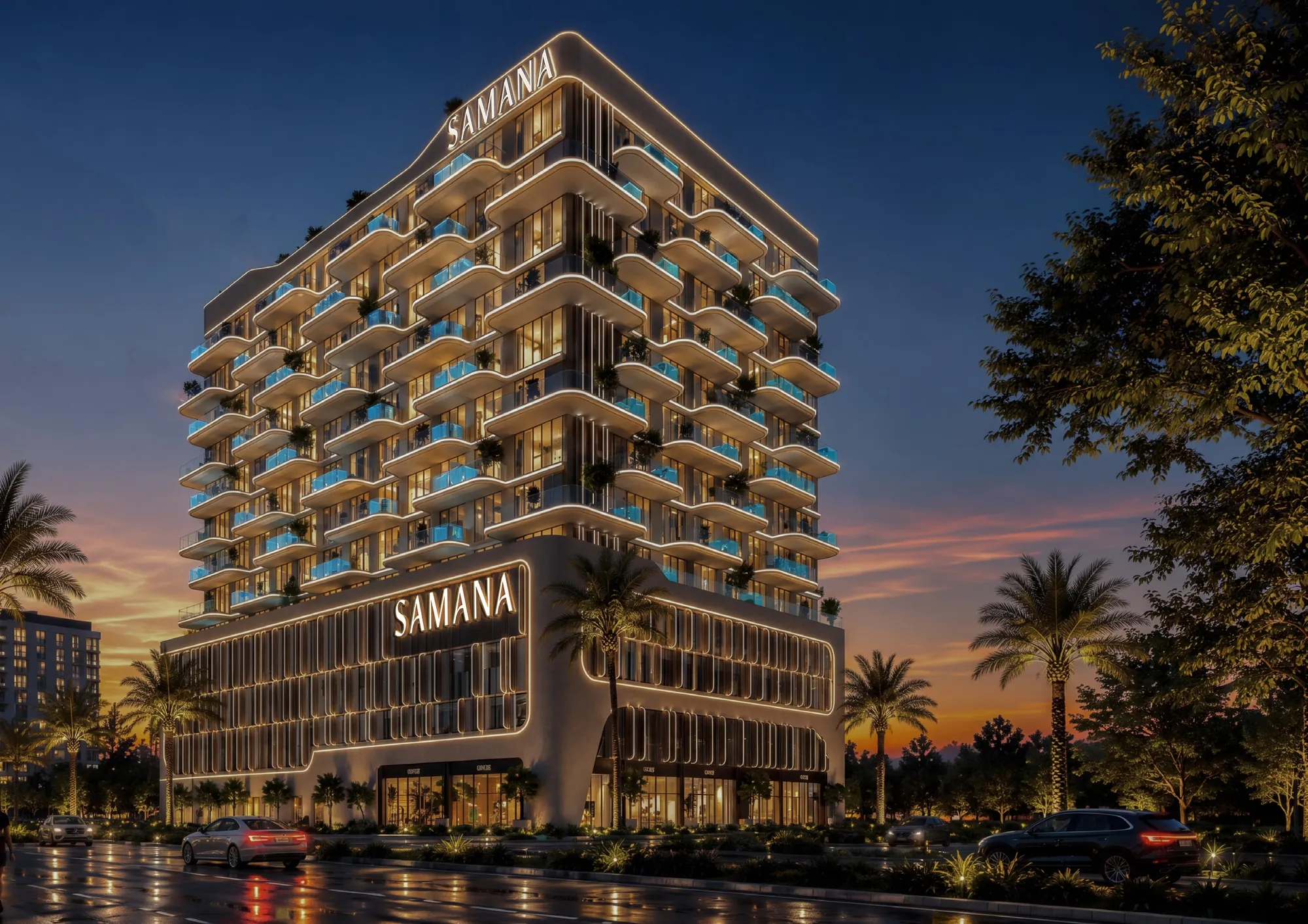
Set the phasing against a specific handover and the picture sharpens. A project like Samana Portside, with an anticipated completion of July 2029, hands over inside the 2028 to 2032 window in which the first major capacity phase is scheduled to arrive. The airline migration, the change most visible to a casual observer, comes later.
That is a more useful frame than the usual one. The question is not whether the airport will eventually transform the south of Dubai. It is which parts of that transformation land inside your holding period, and which arrive after you have made your decision about whether to sell.
How does airport growth translate into property demand?
Through three channels, and they arrive at different speeds.
Construction employment, now. A workforce in the thousands, rising, needs housing, and much of it is housed regionally rather than on site. This is a present tense effect and it is already under way.
Operational employment, from the first terminal phase. Airports are enormous employers, and the staff of an airline hub, ground handling, freight, catering, security, retail and hospitality live within a commutable radius. Jebel Ali sits inside that radius.
Business relocation and logistics, throughout. Cargo capacity of twelve million tonnes a year reshapes where logistics and distribution businesses want to be. Jebel Ali, with its free zone and port already established, is the obvious beneficiary of an airport of that scale being built alongside it.
Those three channels are why the corridor between Jebel Ali, Dubai South and Expo City is where so much residential development has been announced. The demand thesis is employment, not tourism.
What are the risks in this thesis?
It would be dishonest to present a project of this scale as a straight line, so here are the caveats a buyer should hold alongside the optimism.
Timelines on megaprojects move. This particular airport has a long history of announced expansion phases arriving later than first stated. The current programme is more advanced and better funded than earlier iterations, but the base rate for infrastructure of this size is delay rather than acceleration.
Supply responds too. The demand thesis is well understood, which means a great deal of residential supply has been announced along the same corridor. Prices reflect anticipated demand as well as actual demand, and a wave of simultaneous completions can soften rents even in a growing district.
Proximity is not uniformly positive. Being near an airport is good for employment and access. It is not always good for quiet. Flight paths, once operations scale, matter to residential amenity, and they are not something a floor plan will tell you about.
What should a buyer actually do with this information?
- Match your holding period to a phase. If you intend to hold past 2032, the first capacity phase is inside your window. If you intend to exit at handover, you are selling into anticipation rather than into delivery.
- Do not pay for 2035 today. The airline migration is the most transformative phase and the furthest away. Pricing that assumes it has already happened is pricing you should question.
- Weight employment over tourism. The reliable demand from an airport of this kind is the people who work in and around it, not travellers passing through.
- Check the specific site, not the district. Distance to the airport, aspect and future flight paths vary building by building. Our Downtown Jebel Ali location analysis sets out what the developer publishes about the site and what it does not.
How does this compare to Dubai’s other infrastructure bets?
Dubai has a long record of building infrastructure ahead of demand and letting the demand arrive. The Palm, the metro Red Line, Downtown Dubai and Dubai Marina all followed a similar pattern, and in each case the districts that benefited most were those already connected to the road network when the infrastructure landed.
Jebel Ali fits that description well. It is not a greenfield site waiting for a road; it already has Sheikh Zayed Road, a metro line, a port and a free zone. The airport adds a fourth pillar to something already standing rather than a first pillar to something that is not.
That is the strongest version of the argument for the district, and it is worth stating precisely because it does not require the most optimistic timeline to hold.
Questions people ask
How far is Al Maktoum International from Downtown Jebel Ali?
Within twenty minutes according to the SAMANA Developers factbook. That is a developer drive time claim rather than a measured distance.
Is Al Maktoum open now?
Yes. Passenger operations are active while the expansion works continue in parallel.
When will Emirates move there?
Reported phasing places the migration of Emirates and flydubai across 2033 to 2035. As with all megaproject scheduling, treat that as an intention rather than a fixed date.
Will there be a metro connection?
A new metro line linking the airport directly to central Dubai forms part of the ultimate development plan. Details of alignment and timing are a matter for the transport authority rather than for developers.
Does the airport guarantee that property prices will rise?
No. Infrastructure improves the fundamentals of a location; it does not guarantee an individual building’s performance, and it does not protect against oversupply. Read the airport as one input among several rather than as the whole case.
What does the wider Dubai South build out look like?
The airport is not being built in isolation, and the surrounding programme is part of why the demand thesis has weight.
Expo City Dubai occupies the ground immediately to the north east and has been converted from an event site into a permanent mixed use district with business, cultural and residential components. Dubai South, the logistics and aviation district adjacent to the airport, has been developing for over a decade with its own residential and commercial stock. Emaar South sits within the same corridor. And to the west, Palm Jebel Ali adds a substantial waterfront component.
Put together, that is a connected economic and residential zone rather than a single asset. Jebel Ali sits at the northern end of it, closest to the existing city and already connected by road, metro, port and free zone. That position, at the mature end of an emerging corridor, is a materially different proposition to being at its far end.
How have similar infrastructure projects affected Dubai property?
Dubai offers several precedents, and they point in a consistent direction while carrying a consistent caveat.
The Red Line of the Dubai Metro, opened in 2009, made a measurable difference to the desirability of districts along Sheikh Zayed Road, and stations became reference points in listings within a few years. Downtown Dubai and Dubai Marina both grew from largely empty ground into dense, high value districts on the back of committed infrastructure and masterplanning.
The caveat in every case is timing. The uplift did not arrive on the day the infrastructure was announced, or even on the day it opened. It arrived as the population, the retail and the secondary services filled in behind it, which took years. Buyers who did well were those whose holding period was long enough to be present when that happened.
The lesson is not that infrastructure creates value. It is that infrastructure creates the conditions for value, and the conditions take time to be occupied. Match your holding period accordingly.
What would change the thesis?
It is worth naming what would make you wrong, because a thesis that cannot be falsified is not a thesis.
- Material slippage in the terminal phase. If the 2028 to 2032 window moves substantially, the employment growth that underpins near term demand moves with it.
- Oversupply along the corridor. A large number of residential completions arriving simultaneously in Jebel Ali, Dubai South and Expo City could soften rents well before the airport phases land.
- A change in the migration plan. If Dubai International retains more of its operations for longer, the transformation of the south is slower and shallower than currently assumed.
- Wider market conditions. Dubai property has run strongly through 2026. A market wide correction would affect Jebel Ali regardless of what the airport does.
None of these is a reason not to buy. They are reasons to buy at a size and on a timeline you could hold through if one of them happened.
How this connects to a specific purchase
If you are looking at a project in this corridor with a handover in the late 2020s, the practical translation is short.
You will take possession in or around the window when the first major airport capacity phase is scheduled. You will hold through the period when operational employment begins to scale. And the largest single change, the airline migration, sits beyond that, which means it is available to you as upside if you hold, and as a story you are selling if you exit early.
That is a reasonable position to take, provided you take it deliberately. What it is not is a guarantee, and any agent presenting the airport as one should be asked which phase, on what date, and according to whom.
For the site specific picture, including what SAMANA publishes about distances and what it does not, see the Downtown Jebel Ali location analysis. For the district in the round, read the Downtown Jebel Ali area guide.
Next steps on Samana Portside
Related guides

Buying in Dubai as a Foreign National: Freehold, the Golden Visa and the Real Thresholds
What foreign nationals can actually own in Dubai, how the Golden Visa property route really works, the published fees, and the detail that trips up off plan buyers.
20 August 2026 9 min read

Fees and Costs When Buying Off Plan in Dubai: The Full Breakdown
Every cost that sits outside the purchase price on a Dubai off plan purchase, when each one falls due, and the ones buyers most often forget to budget for.
20 August 2026 8 min read

Buying Off Plan in Dubai: Escrow, Oqood and the SPA, Step by Step
The full process of an off plan purchase in Dubai, the protections that sit underneath it, and the specific checks that separate a safe transaction from a careless one.
20 August 2026 9 min read
Ask for availability and the current price list
Send your details and our team will come back with the units still open, the layouts that match your budget, and the unit areas as soon as the developer releases them.